

All products are independently selected by our editors. If you buy something, we may earn an affiliate commission.
Pierre-Auguste Renoir’s paintings capture the pleasures and complexities of human relationships with remarkable warmth. His depictions of lively Parisian gatherings, intimate conversations and quiet moments of affection remain among the most recognisable works of Impressionism. At London’s National Gallery, Renoir and Love explores this defining aspect of his career through an exceptional collection of 40 paintings.
Presented in the Gallery’s Sainsbury Wing, the exhibition focuses on Renoir’s artistic development during the 1860s to 1880s, when his fascination with friendship, romance and everyday life helped shape his distinctive style. With major international loans, including the first UK display of Bal du Moulin de la Galette, it offers a rare opportunity to appreciate some of his finest works together.
Renoir and the Art of Human Connection
As a leading figure of Impressionism, Renoir helped transform the representation of modern life in painting. He drew inspiration from the cafés, gardens, dance halls and leisure spots of 19th-century Paris, capturing the people and social encounters that defined the period.
Human relationships became central to his work. Friends enjoying a meal, couples dancing and families sharing quiet moments provided opportunities to explore affection, companionship and everyday social customs. His expressive brushwork, luminous colours and treatment of natural light brought spontaneity and movement to these scenes, even when their compositions were carefully arranged.
Renoir and Love traces the first two decades of his career, revealing how his approach to portraiture and group compositions developed alongside his interest in human connection. The exhibition also explores the breadth of his interpretation of love, encompassing romance, friendship, family relationships and the simple pleasures of spending time together.
The Exhibition’s Most Remarkable Paintings
The exhibition brings together major works from international collections, offering a compelling overview of Renoir’s artistic development and the subjects that inspired him.
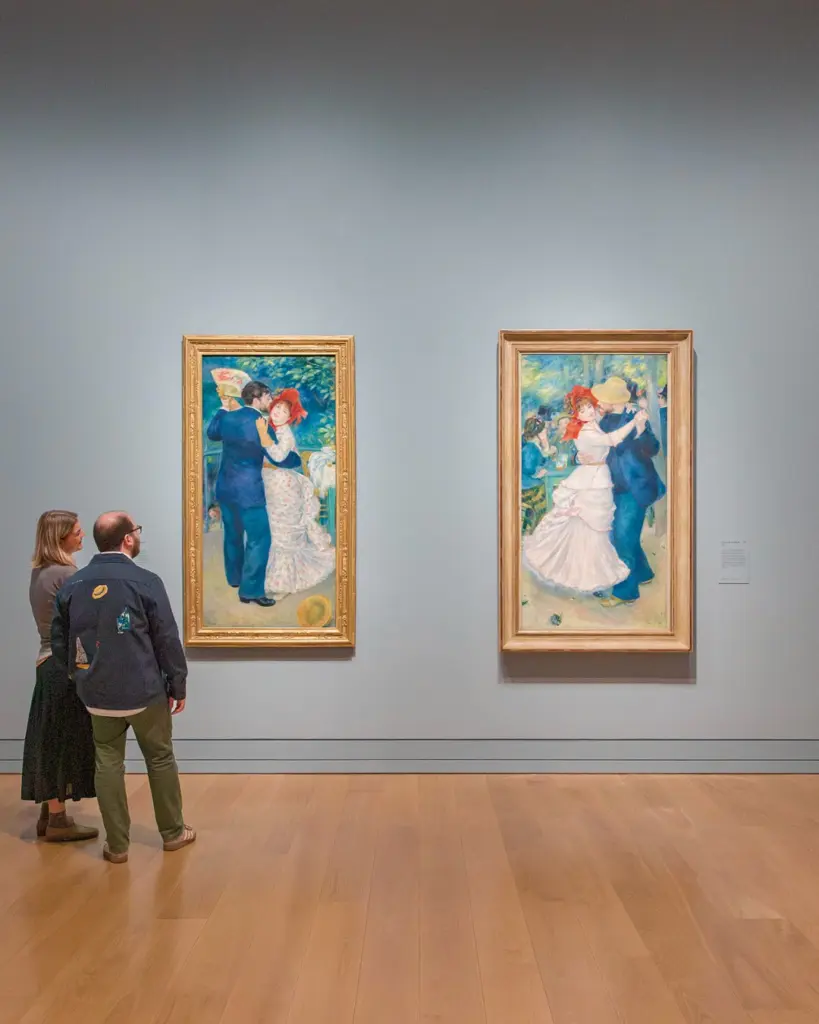
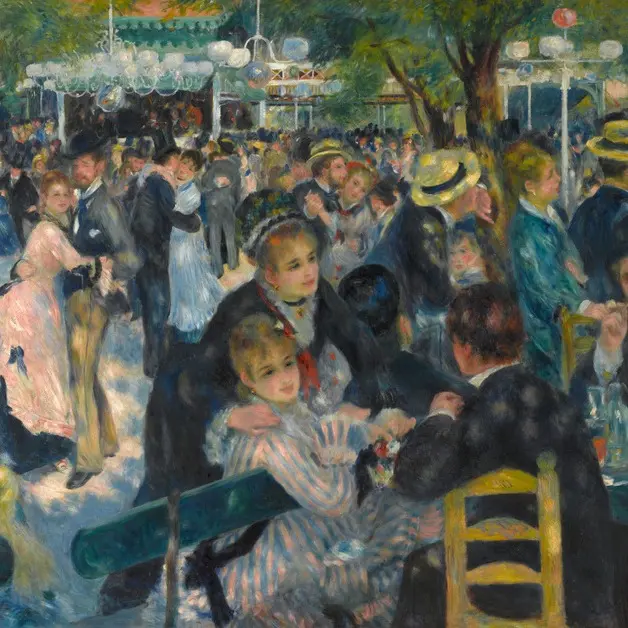
Its centrepiece is Bal du Moulin de la Galette (1876), on loan from the Musée d’Orsay in Paris and displayed in the UK for the first time. Depicting a bustling outdoor dance gathering in Montmartre, the painting is among Renoir’s defining achievements and one of Impressionism’s most celebrated works.
Dancing couples, seated friends and animated conversations fill the composition, illuminated by sunlight filtering through the trees. Renoir’s distinctive treatment of light and movement captures the energy of Parisian social life, while the arrangement of figures creates a remarkable sense of immediacy.
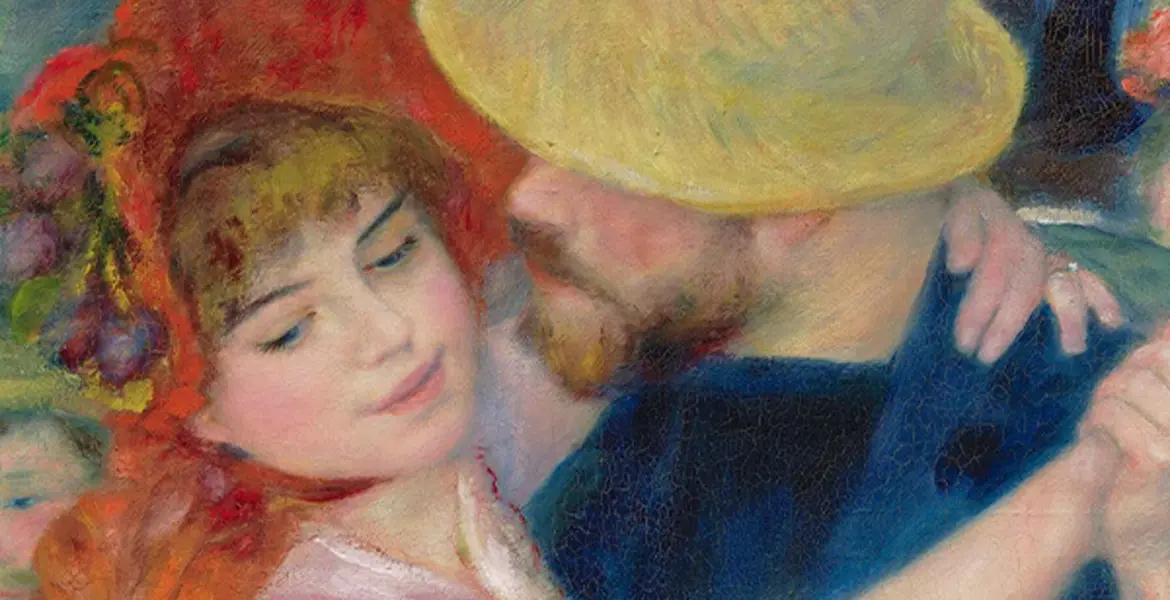
Dance at Bougival (1883), from the Museum of Fine Arts, Boston, offers a more intimate interpretation of social interaction. The painting centres on a dancing couple, their figures dominating the composition as the surrounding activity recedes into the background. The woman’s vivid red bonnet and the contrast between their clothing draw attention to the pair, creating a striking impression of movement and romantic possibility.
Another highlight is Lunch at Restaurant Fournaise (The Rowers’ Lunch) (1875), from the Art Institute of Chicago. Set at a popular riverside restaurant, the painting portrays a relaxed gathering associated with leisure along the Seine. Its informal composition reflects Renoir’s fascination with friendship and contemporary social life.
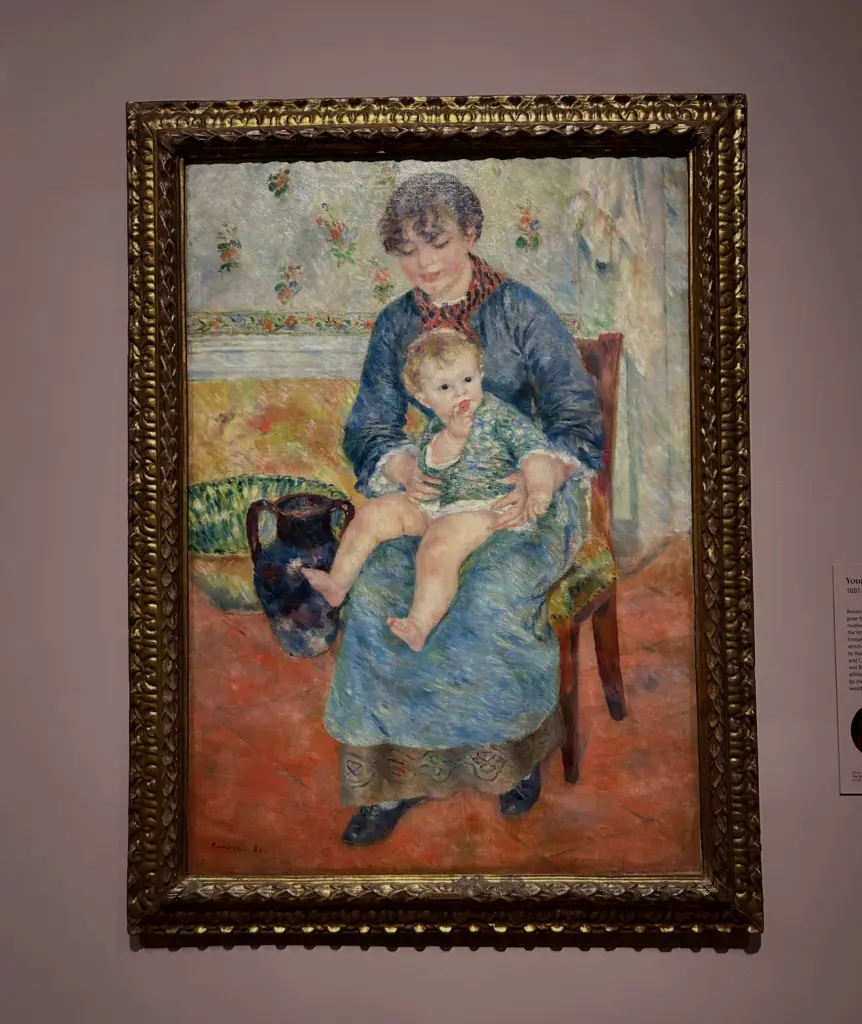
Quieter expressions of affection emerge in Young Mother (1881), on loan from the Barnes Foundation in Philadelphia. Its portrayal of maternal tenderness provides a contrast to the lively gatherings elsewhere in the exhibition, demonstrating Renoir’s sensitivity to more personal relationships.
Earlier works such as Mother Antony’s Tavern (1866), from Stockholm’s Nationalmuseum, reveal his developing interest in informal group scenes. His Self-Portrait (about 1875), from the Clark Art Institute, offers a glimpse of the artist during an important period of creative experimentation.
Together, these paintings demonstrate Renoir’s versatility and his ability to convey human emotion through both bustling social scenes and intimate encounters.
Experiencing Renoir and Love at the National Gallery
The National Gallery’s Sainsbury Wing provides the setting for this significant gathering of Renoir’s paintings. Bringing works from major international museums into one exhibition allows visitors to explore connections between his subjects, compositions and evolving technique.
The contrast between the animated atmosphere of Bal du Moulin de la Galette and the intimacy of Dance at Bougival is particularly revealing. Both explore social interaction, yet their compositions convey different aspects of human connection. Paintings such as Young Mother extend this exploration into quieter domestic settings.
Viewing the works in person also provides an opportunity to appreciate Renoir’s technique more closely. His expressive brushwork, subtle colour combinations and treatment of natural light reveal details that are easily overlooked in reproductions, particularly the relationships between figures and their surroundings.
Organised jointly by the National Gallery, the Musée d’Orsay and the Museum of Fine Arts, Boston, the exhibition is especially rewarding for admirers of Impressionism. Its international loans bring together paintings that would ordinarily require visits to several major collections.
Tickets, Membership and Gallery Experiences
Renoir and Love is presented at the National Gallery in Trafalgar Square, with admission available through the Gallery’s exhibition ticketing programme. Visitors can choose from standard admission and selected alternative entry options, including Quick Visit tickets and Friday evening Pay What You Wish sessions, subject to availability.
National Gallery Members enjoy unlimited complimentary admission to paid exhibitions, alongside access to special events and other membership benefits. This offers additional flexibility for those interested in returning to explore individual paintings in greater detail.
The accompanying cultural programme includes curator-led talks, online exhibition tours and discussions exploring Renoir’s artistic legacy. Among these is Beyond Love and Beauty: Renoir and Modern France, offering further context on the artist and the society he depicted.
The Gallery also offers private and group tours through its wider visitor programme, although access to temporary exhibitions should be confirmed separately.
Renoir’s Celebration of Life and Love
Renoir and Love offers a thoughtful exploration of the artist’s fascination with human relationships, bringing together celebrated masterpieces and lesser-known works that illuminate his development during a defining period of Impressionism.
The first UK display of Bal du Moulin de la Galette is a particular highlight, while the wider collection provides a richer understanding of Renoir’s treatment of affection, companionship and everyday life. For art enthusiasts and visitors exploring London’s cultural calendar, the exhibition is a notable opportunity to experience some of his most accomplished paintings in one setting.
Location: The National Gallery, Trafalgar Square, London WC2N 5DN