

All products are independently selected by our editors. If you buy something, we may earn an affiliate commission.
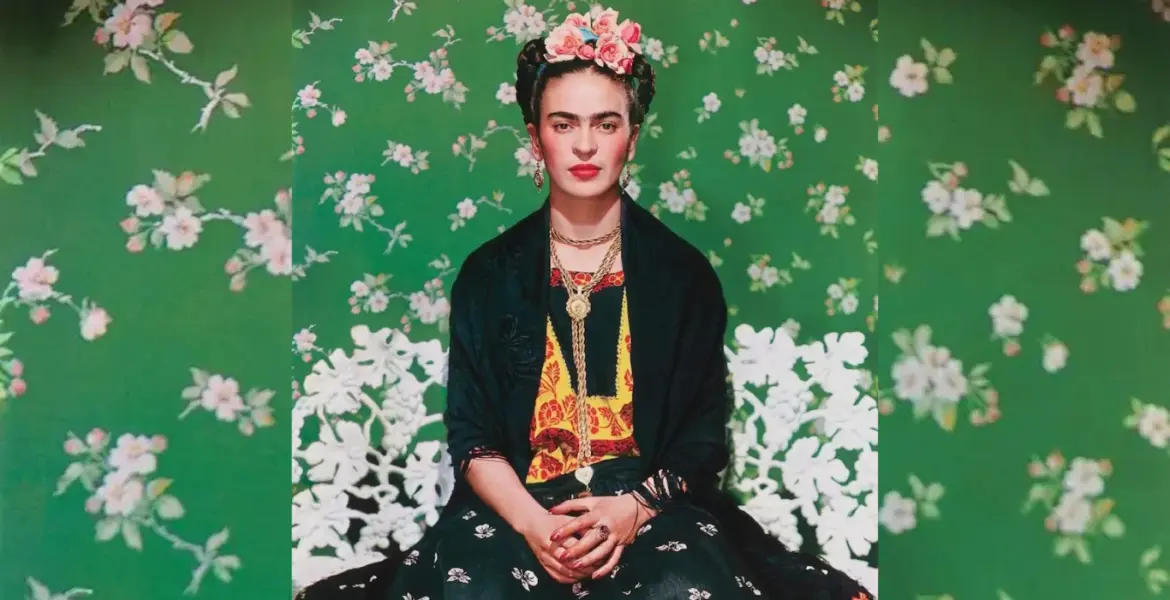
Frida Kahlo’s image has become almost as recognisable as her paintings. Flower crowns, traditional Mexican dress and that unmistakable gaze have travelled far beyond galleries into fashion, photography and popular culture. Frida: The Making of an Icon at Tate Modern examines how this transformation happened while returning attention to the artist and her work.
Running until 3 January 2027, the exhibition brings together more than 30 works by Kahlo alongside photographs, garments, jewellery and personal material. These sit alongside works by artists influenced by her across several generations, before the exhibition turns to the extraordinary commercial afterlife of the Frida image.
The Artist Behind the Icon
Born in Coyoacán, Mexico, in 1907, Kahlo developed an artistic identity closely tied to her own life. Illness, disability, politics, Mexican culture, relationships and the body recur throughout her work, while self-portraiture became an important means of exploring her identity.
Tate presents Kahlo as an intellectual, political activist, modern artist and wife, with photographs and personal objects adding context to the paintings. Her relationship with Diego Rivera inevitably forms part of the story, though the focus remains on Kahlo’s artistic development and the deliberate way she presented herself.
Kahlo understood the visual power of dress and self-presentation during her lifetime. Photographs and personal material reveal how actively she shaped the image that would later become so widely reproduced.
Self-Portraiture, Symbolism and Identity
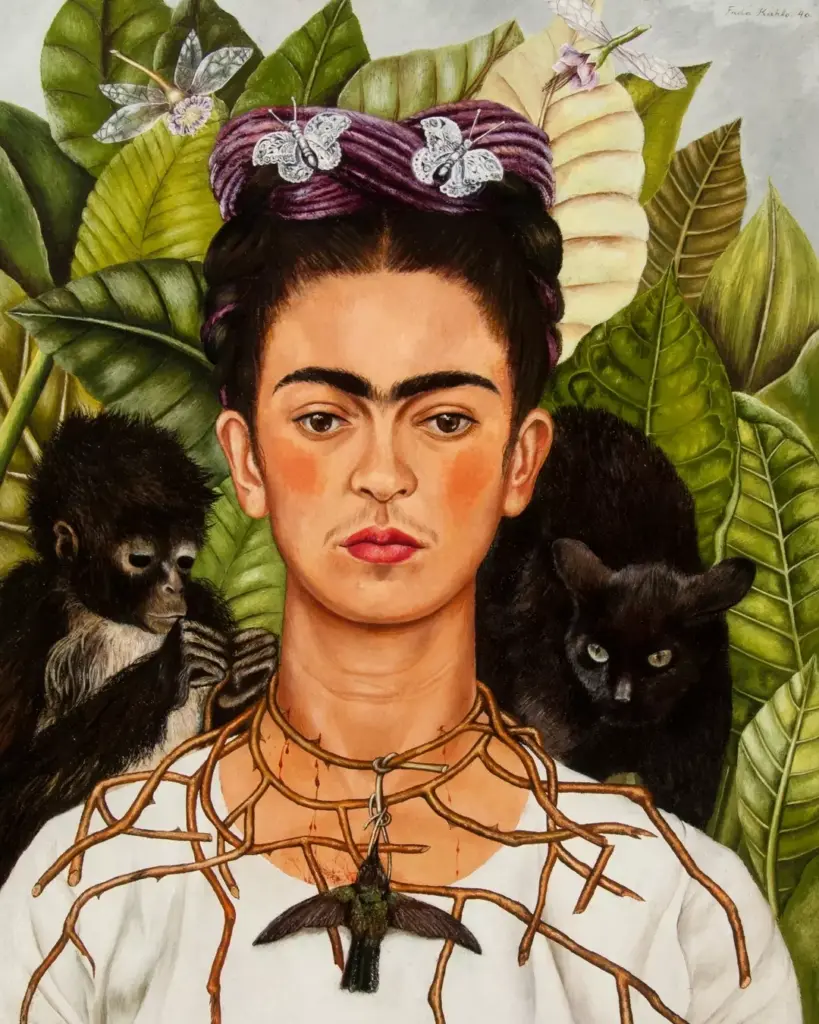
Kahlo’s paintings anchor the exhibition. Rarely seen self-portraits sit among more than 30 of her works, bringing together paintings now dispersed across public and private collections.
Self-Portrait with Thorn Necklace and Hummingbird (1940) is among the defining works on display. Kahlo faces the viewer directly, surrounded by foliage, with a thorn necklace cutting into her neck and a hummingbird suspended beneath her throat. A black cat and monkey appear behind her shoulders, completing a composition rich in the symbolism characteristic of her self-portraits.
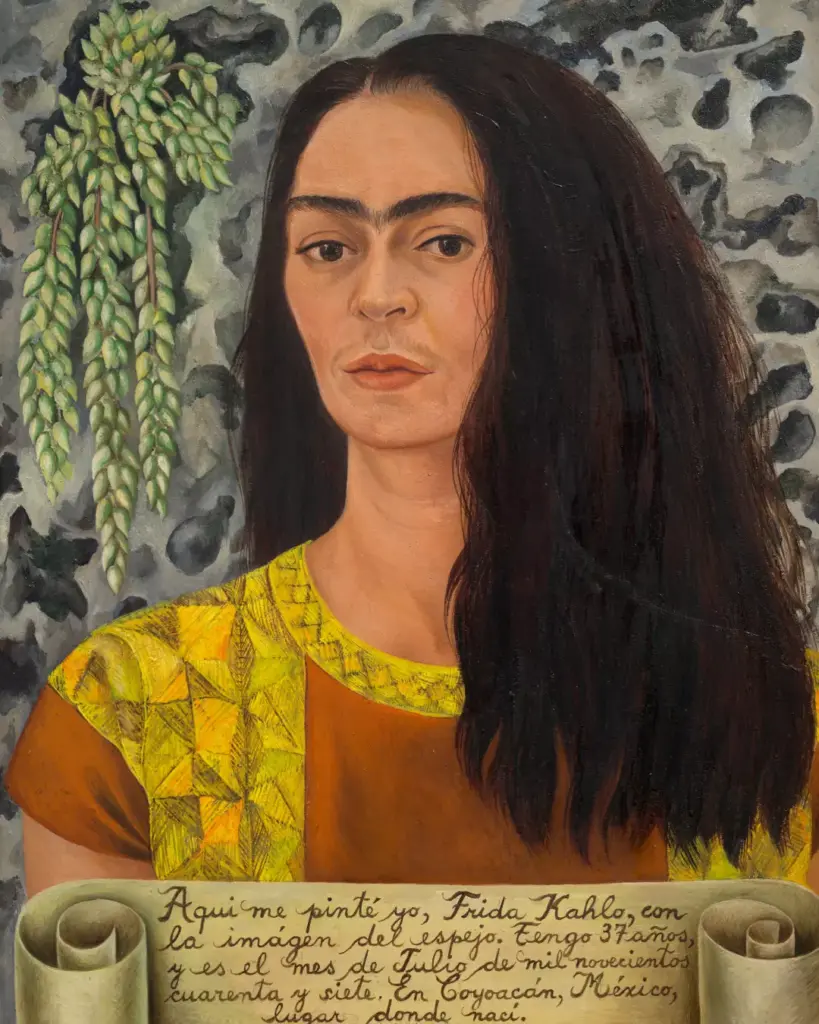
Self-Portrait (With Velvet Dress) (1926), painted early in her career, shows a younger Kahlo already experimenting with self-presentation. Self-Portrait with Loose Hair and the later Self-Portrait with Dr. Farill reveal how that visual language developed over subsequent decades.
Other works widen the focus. Memory (The Heart) (1937) uses bodily imagery to address emotional pain, while The Suicide of Dorothy Hale (1938) recounts the death of American actress Dorothy Hale through a stark narrative composition. My Dress Hangs There (1933), painted during Kahlo’s time in the United States, turns towards American capitalism and society through symbols of industry, religion, wealth and mass culture.
Together, the works reveal a practice broader than the self-portraits for which Kahlo is best known, bringing her political, cultural and personal concerns more clearly into view.
The Making of Frida
Kahlo died in 1954, yet her cultural presence grew dramatically in the decades that followed. Tate traces the point at which her image began to circulate increasingly independently of her paintings.
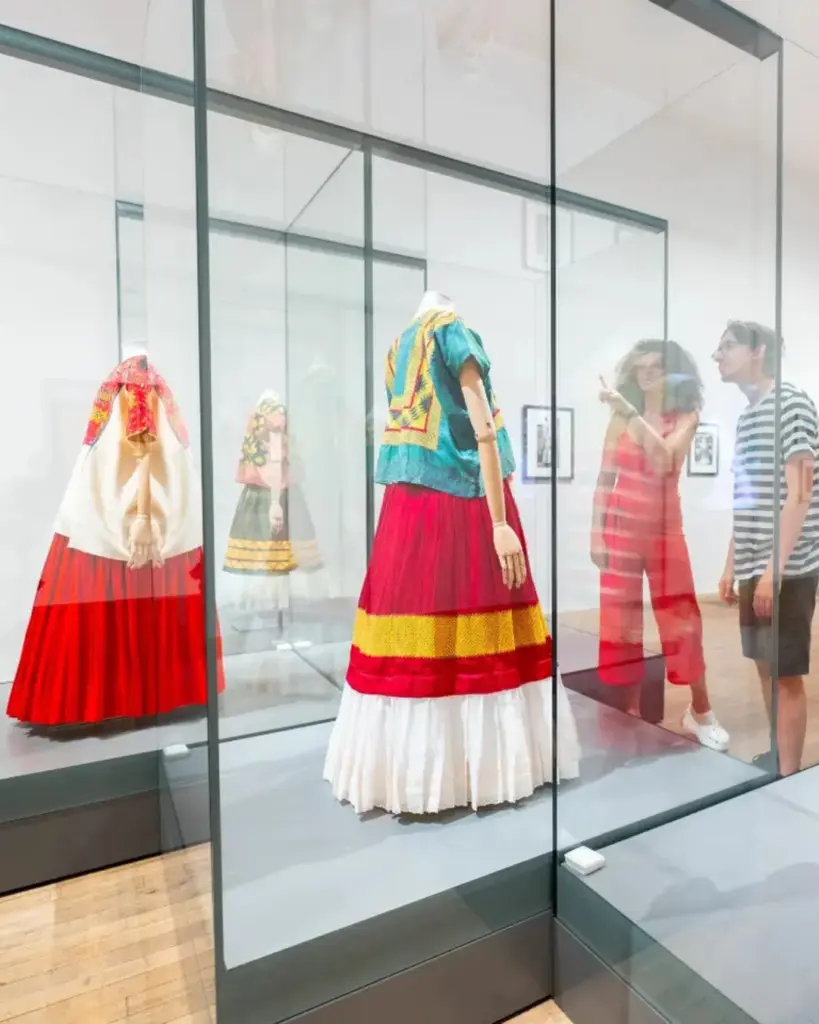
Photography is central to this story. Kahlo was photographed extensively, and her clothing, hairstyles, jewellery and engagement with the camera established a visual identity that could be reproduced long after her death. Garments and jewellery provide further context, placing these now-familiar details within her Mexican identity and approach to self-presentation.
The exhibition then follows the expansion of that image into what Tate calls “Fridamania”. More than 200 commercial objects demonstrate the scale of Kahlo’s transformation into a global brand, with her likeness reproduced across fashion, publishing, design and merchandise. Coming after the paintings and personal material, the display makes the distance between Kahlo’s own image-making and her later commercial identity particularly striking.
A Legacy Recast
Kahlo’s influence extends through work by later artists who have engaged with her art, biography and image. More than 80 artists are represented across the exhibition, spanning different generations, countries and practices.
Rupert García’s September (1975) is an important early example. His screenprint brought Kahlo’s image into a new American context, demonstrating how her likeness could acquire fresh political and cultural associations.
Nalini Malani’s Old Arguments on Indigenism (1989) places Kahlo alongside Indian-Hungarian painter Amrita Sher-Gil to consider Indigenous identity and activism. Martine Gutierrez approaches questions of identity differently in Demons, Tlazoteotl ‘Eater of Filth’ (2018), drawing on the visual language of fashion editorials while engaging with Indigenous representation.
Mary McCartney’s Being Frida (2000) depicts Tracey Emin reclining in bed while channelling Kahlo. The image connects Kahlo with another artist whose body and personal experiences have played a significant role in her work.
Artists including Ana Mendieta, Judy Chicago, Carrie Mae Weems, Kiki Smith, Catherine Opie and the Guerrilla Girls further demonstrate the breadth of Kahlo’s influence and the different ways her legacy has been interpreted.
Curating Artist and Icon
The exhibition gains much of its strength from the relationship between these strands. Kahlo’s paintings establish the artistic foundation, photographs and personal objects provide context for her carefully constructed identity, and later works reveal how subsequent generations have interpreted it.
This progression also gives the “Fridamania” display greater impact. By the time the exhibition reaches its commercial objects, visitors have already encountered Kahlo through her paintings, personal material and artistic legacy. The sheer scale of her reproduction consequently feels all the more pronounced.
There is plenty to absorb, with Kahlo’s work joined by art from several generations and hundreds of objects associated with her cultural afterlife. Tate’s optional smartphone audio guide offers additional material on “Fridamania” for those wanting further context.
The exhibition ultimately presents several versions of Kahlo at once: painter, photographed subject, political figure, artistic influence and commercial icon. Their coexistence reveals how complex her legacy has become.
Visiting Tate Modern
Frida: The Making of an Icon runs at Tate Modern until 3 January 2027. The ticketed exhibition is located in the Natalie Bell Building.
Advance booking is available through Tate, while Tate Members receive free exhibition entry. Visitors can also add the exhibition’s smartphone audio guide when booking.
The Enduring Frida
Frida: The Making of an Icon gives Kahlo’s paintings the space they deserve while examining the extraordinary cultural identity that developed around them. The photographs, personal objects and later artistic responses help trace that evolution without losing sight of Kahlo’s own practice.
By the time the exhibition reaches “Fridamania”, the familiar Frida image carries a different weight. Tate leaves the artist and the icon side by side, revealing the remarkable scale and complexity of her legacy.